

Almost 10 years ago, I was sent on a mission.
At the time, I was the CMO at Rocket Internet. We were obsessed with data. Excel was religion. We built companies on speed, execution, and numbers.
Then Global Founders Capital (our venture capital firm) invested in a small D2C luggage startup in New York called Away.
They were growing fast.
But one of the founders told me something that sounded almost illegal in our world:
“There’s only one person in this company with Excel on their laptop.”
Rocket’s CEO, Oliver Samwer, wanted to understand how that was possible.
He told me:
“Go to New York. Reverse-engineer what they do. Come back with a case study.”
So I did.
What I expected to find was some hidden growth algorithm.
What I found instead was a brand machine.
I spent a week studying their model and wrote a 10-chapter case study when this was happening.
Today, almost a decade later, I’ve digitized that original document and turned it into a D2C growth blueprint.
If anything, it matters more now than it did in 2016. Ads are more expensive. Tracking is worse. Performance alone doesn’t carry companies anymore.
I originally wrote this in the present tense, and I’ve kept it that way so you can experience it as if it were released today.
Here is the playbook.
Introduction
Away is a New York-based company selling high-end smart luggage primarily online, founded in 2015 by Jen Rubio and Steph Korey, two former Warby Parker executives.
With its first suitcases shipped in February 2016, the company reached $10 million in revenue in its first year.
Away’s impressive early-stage growth did not come directly from SEM, SEO, Facebook ads, or other performance marketing channels. Instead, it was driven by a mix of storytelling, PR, brand marketing, partnerships, influencer marketing, and an excellent product and customer experience.
After all, luggage is a commodity and the market is highly competitive. Moreover, the amount of high-intent traffic available online is limited. Beyond the carry-on’s tech feature (it can charge smartphones on the go) and price, Away chose to differentiate itself by building a brand and a community, guided by the idea that “any other company can create identical luggage, but no one can copy the brand.”
The drivers behind Away’s growth are summarized below in ten recommendations, followed by a conclusion:
1. Always look for opportunities to tell a compelling story
Funding and launch
Before shipping the first suitcase, Away had already been featured in nearly 100 press articles. The two founders, Steph and Jen, launched the company at the right time and told the right story to the media. Here are the key elements behind their early PR success:
Away was not the first company trying to lower the cost of premium goods through a direct-to-consumer model. This is exactly what Warby Parker and Casper did in the eyewear and mattress industries, respectively.
The founders’ backgrounds made them strong candidates to disrupt the luggage market. Steph previously served as Head of Supply Chain at Warby Parker, while Jen was Head of Social Media at the same company. As they explained:
“While working at Warby Parker and Casper, we saw those companies completely transform the previously poor consumer experience and high prices in the eyewear and mattress industries. In January of that year, we decided the luggage industry needed similar improvements. So we created Away to offer consumers high-quality luggage at a fraction of the traditional price, combined with a great customer experience.”
Both founders were named to the Forbes 30 Under 30 list, which helped drive additional coverage, particularly from tech and business media.
Last but not least, a $2.5 million seed round co-led by Forerunner Ventures and Accel Partners further increased media attention.
The product
Beyond the launch and funding, the product features themselves made the suitcase highly appealing to technology, design, and fashion media.
A built-in 10,000 mAh battery that can be charged in advance and power a smartphone up to five times during a trip turned the carry-on into a true smart suitcase.
Four rotating double wheels, an internal laundry separation system that keeps belongings organized, a scratch-resistant shell, and TSA-approved YKK zippers position the luggage as a design-driven product.
What’s next?
Although funding, launch and product articles represent the vast majority of press coverage and help boosting brand awareness in the first year, Away was able to be on the top of mind of journalists by continuously crafting and telling compelling stories.
Below some examples of other stories that generated strong press coverage:
Packyourbag.co: One of the early PR hacks of Away (covered in one of the next chapters), was the website packyourbag.co. The e-commerce website (available for just one month) would allow visitors to drag and drop travel essentials from different partnering companies into an Away suitcase and check out. Visitors could either shop the products or participate a sweepstake and win all of them along with a trip. Beside generating a high amount of leads, a well told story to the press made a simple shopify website appear as the e-commerce of the future in the eyes of journalists.
The monogram edition: In April and again in December, Away assembled New York-based artists Scott Biersack, Jen Mussari, and Alaina Sullivan to paint up to three letters in a variety of colors on any of the Away Carry-On models for $35 more than the standard price. While the monogram edition didn’t generate a high volume of additional revenues, artists painting luggages was another great story for the press and Away achieved coverage in several “top gifts for the holiday seasons” articles.
International expansion: With a moderate investment, Away opened temporary stores in London and Berlin. Sales in the stores were not equally successful in both locations but the press considered the move as a sign of international expansion, which helped Away appear as a global brand.
Growth and funding: More obvious stories to tell are the growth and funding achievements. $10 million revenues, seed and series A funding all generate high coverage.
Limited editions: In general, both journalists and customers are attracted by scarcity and limited edition products always make a good story. Beside packyourbag.co and the monogram edition, Away produced several limited edition products, some of which covered in the next chapters.
Key press articles can be found here.
2. Amplify the reach of engaging stories with social media ads
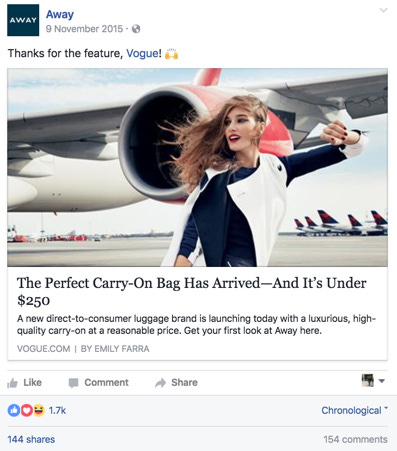
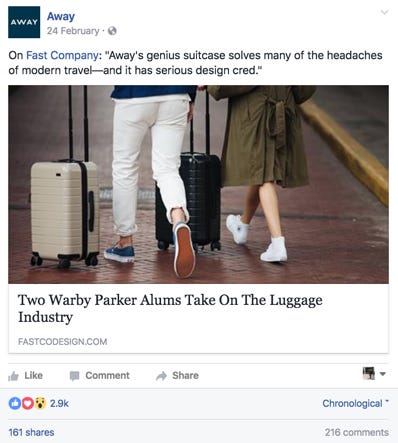
The following two Facebook ads are the ones which generated the highest engagement of all time for Away:
Remarkable elements of these successful Facebook Ads
The ads above act as a brand endorsement from Vogue and Fast Company. They give Away high credibility as a fashion and design company.
High engagement. Not only the target audience is more likely to engage with an editorial from an iconic company such as Vogue compared to content on your website, but also you will be able to reach a bigger audience for a much cheaper price. $5 CPM, >5% CTR, more than a million people reached and a high relevance score are quite rare among companies. An ad with a relevance score of 9 has a CPM which is about half that of an ad with a relevance score of 5 targeting the same audience. Moreover, shares, likes, comments and tags can generate a high amount of organic traffic which is not measured on Facebook business manager or google analytics.
These ads did not link to the Away website. Instead, they directed users to editorial articles, not product pages.
So how do you measure the success of these ads in Google Analytics in terms of traffic and conversions? You don’t, at least not directly.
You can track referral traffic from Vogue and measure the conversions associated with that traffic, but that will only show part of the picture.
Is it still worth doing? Absolutely.
Are there other signals that the article helped drive sales? Just read the comments below it. High engagement on a highly relevant article is a strong indicator that the content resonated.
Of course, not everyone leaves a comment after buying a suitcase, so you cannot reverse-engineer the exact number of sales generated by the article. But strong engagement around a relevant story is a meaningful proxy for impact.

These two ads are boosted posts and standalone ads in relation to the rest of the Facebook account. The Facebook account is structured along funnel and recency dimensions, from custom audiences to lookalikes, non overlapping audiences and oCPM bidding on the funnel step generating enough volume to properly calibrate the algorithm, just like most of the companies at Rocket Internet. None of the ads within the analytical structure shows by far the reach, engagement and CPM of these two boosted posts.
Last but not least, pushing traffic to this article means supporting the Vogue editor to reach her own KPIs. Every editor cares about traffic and clickthrough rates for her own articles, because that’s how an editor is judged by her company / supervisors. The success of this article in fact led Away to secure free exclusive coverage from Vogue on the next partnership. This is something you don’t see on Google Analytics.
3. Create demand and urgency to buy your product
“The places we return to”
At the time Away sold its first 1,200 carry-on luggages ($270k of revenues), none of them were actually produced and in stock. Jen and Steph wanted to prove there was demand for such product but, in an effort to build a high end company, they decided it was not a good idea to do kickstarter, so they had to come up with a plan to generate demand and pre-orders.
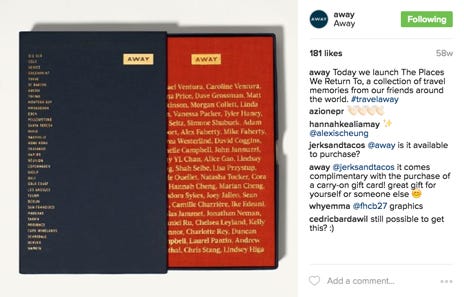
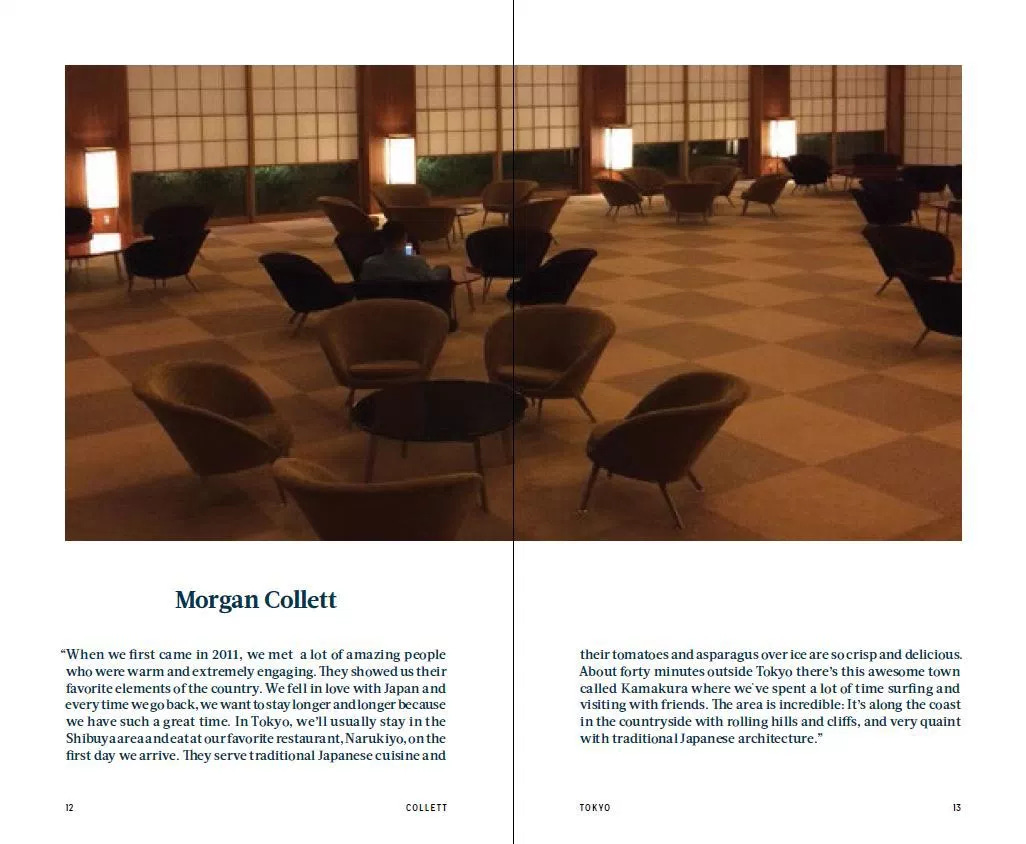
It was September, the product would officially be shipped only starting from February next year and waiting lists wouldn’t work for a product that didn’t exist yet. They decided instead to create a limited edition travel book, titled “The Places We Return To”, and complement pre-orders with the book. This book would be stuffed with personal anecdotes and images from 35 notable world travelers, including Morgan Collett of Saturdays Surf, Tyler Haney of Outdoor Voices and Kelly Connor of Vogue, all interviewed by the New York Times writer Alexis Cheung. More contributors below:
Michele Ouellet, model and co-founder of Lorenza Wine
John Jannuzzi is the US Deputy at Twitter Moments
Adam Rapoport, Editor in Chief of Bon Appétit magazine
Marian Cheng, co-founder of Mimi Cheng’s Dumplings
Alice Gao, photographer based in New York
Not only featuring socially influential people in the book helped creating brand awareness within the social sphere of the contributors, but also it generated demand for the product and all 1,200 copies were sold fast.
Packyourbag.co
In May, Away joined forces with four direct-to-consumer brands to create the ultimate travel essentials online shop at packyourbag.co. Lasting for just a month, you could shop vacation selects from grooming company Harry’s, activewear line Outdoor Voices, and womenswear brand AYR, all packed inside the near-perfect carry-on suitcase from new travel brand Away.
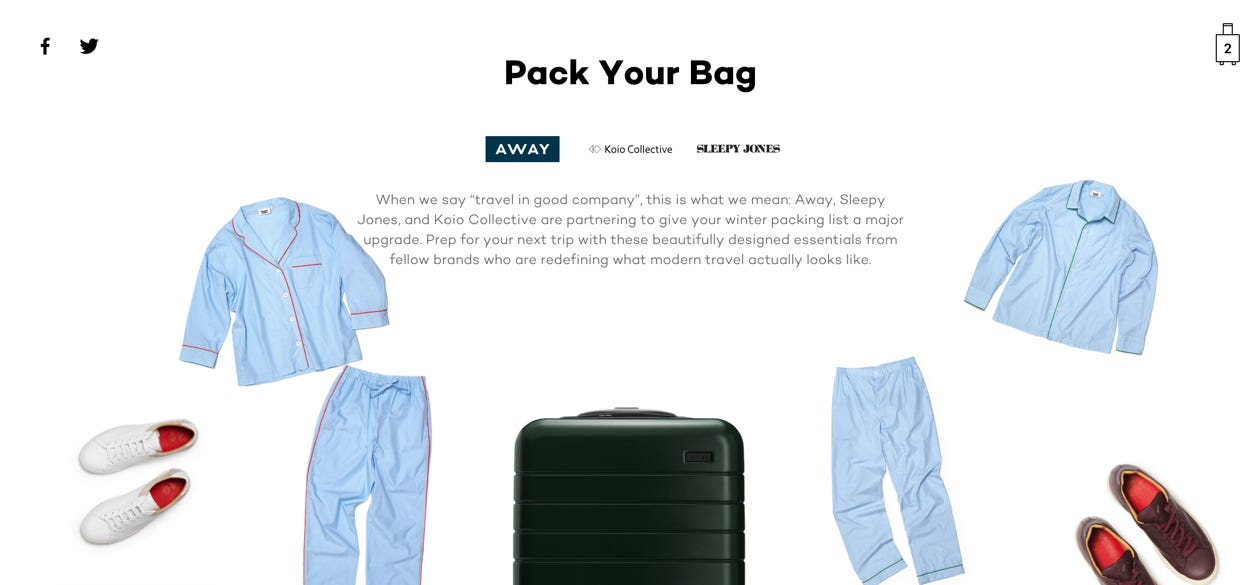
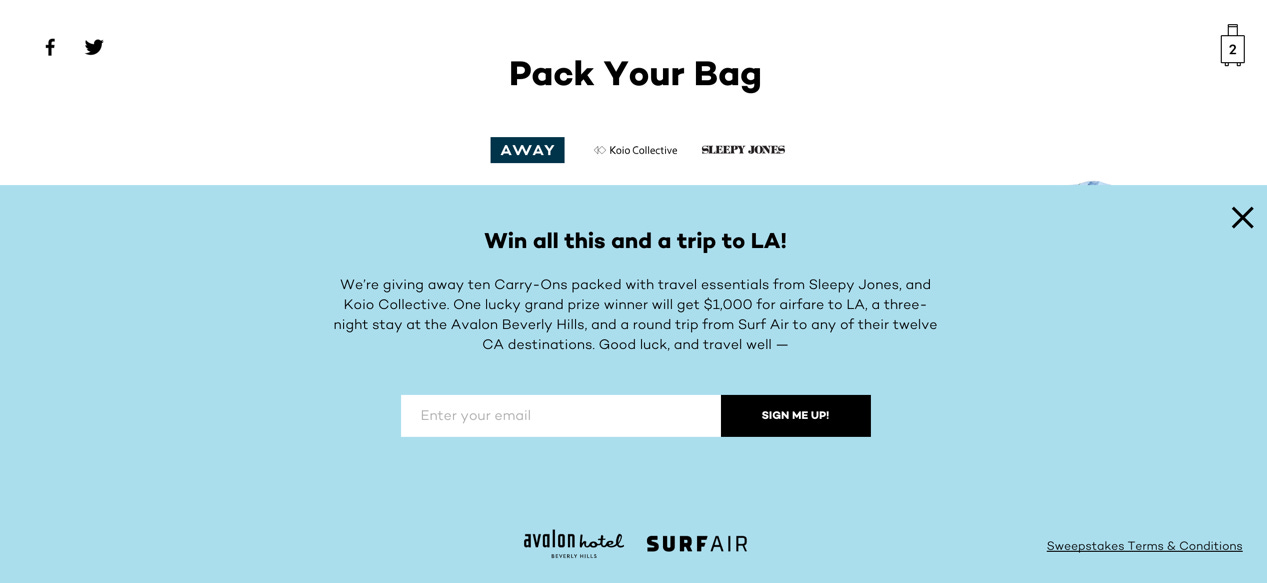
Behind the scenes this is just a simple Shopify website, but a good story to the press made adding products from different brands to a travel suitcase appear like the ecommerce experience of the future.
Not only this out of the box partnership resonated with the press, but also helped Away collect 50k email addresses, by encouraging urgency to participate. In fact, users could either buy any of the products or participate a sweepstake and win all of them along with a trip (paid by the partners).
Pop & Suki Partnership
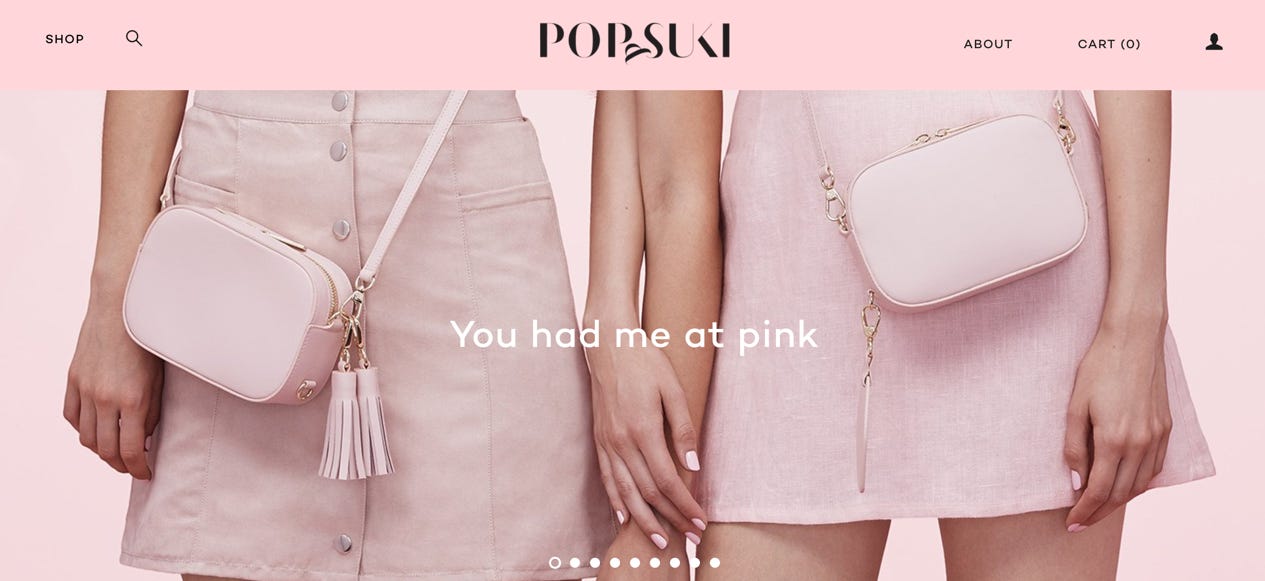
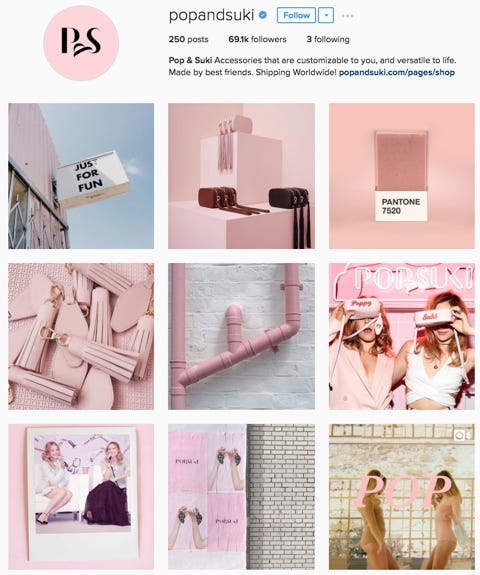
Pop & Suki is a fashion brand built by the model Suki Waterhouse (1.1 million followers on Instagram) and the tv presenter Poppy Jamie. Beside the influential power of the founders and the press they attract, the main theme behind Pop & Suki products is the color pink, a good opportunity to do co-branding.
Away will create 500 pieces of a limited edition pink suitcase set for Pop & Suki and Vogue obviously already accepted to have the exclusive on the coverage, for free.
On top of that, having a limited edition version of the product will fuel urgency to buy the product and those users who won’t be the first to buy it will eventually buy one standard product.

4. Don’t target your audience directly, partner with companies that are already an authority for that audience
One of the key growth strategies of Away is that of partnering with companies that are an authority for its target audience.
Instead of reaching its target audience directly with performance marketing ads, Away looks for established brands to partner with. Partnering with these companies helps Away to gain trust and credibility from potential customers.
These brands usually accept to partner with Away because of its ability to attract press and because of its influencer network (more in one of the next chapters).
Key partnerships include packyourbag.co with Outdoor voices and the partnership with Pop & Suki, as described in the previous chapter.
The first few partnerships were started by Away and took up to six meetings to be finalized. As of today, Away doesn’t have to source partnerships anymore as companies such as Tesla or the NBA ask Away to partner with them.
Aesop Partnership
Another example of successful partnerships is the one with the skincare brand Aesop. Through the partnership, Away got travel-size Aesop products at cost and included them in a gift set packed in a miniature case along with a pair of socks:
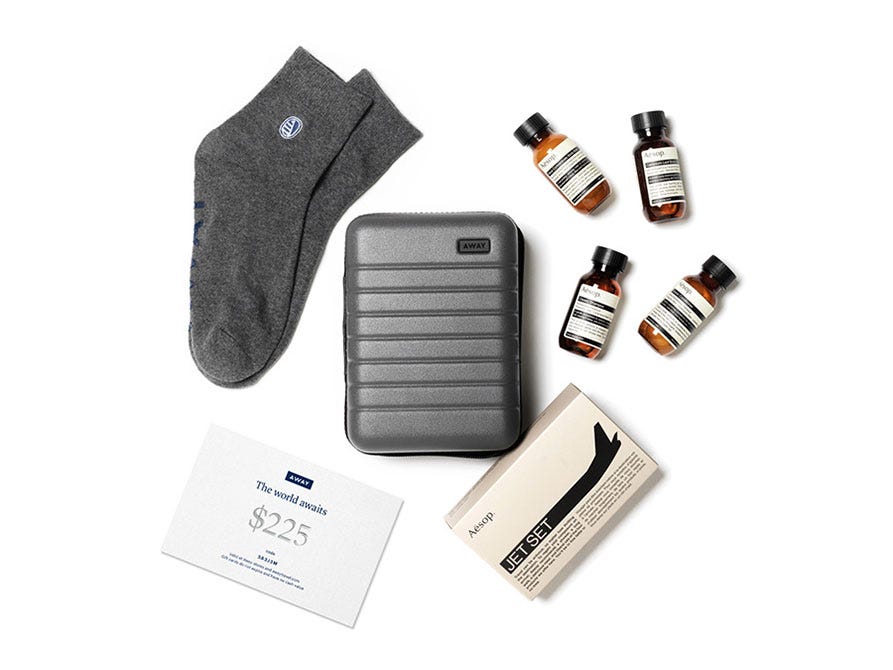
Many other brands asked Away to partner with them after seeing the Aesop partnership. Brand association is a fundamental part of Away strategy.
Violet Gray Partnership
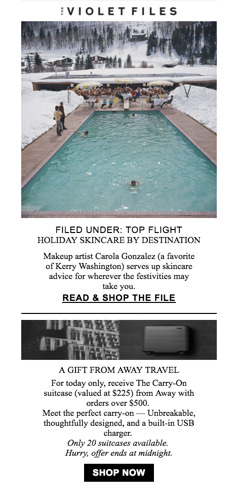
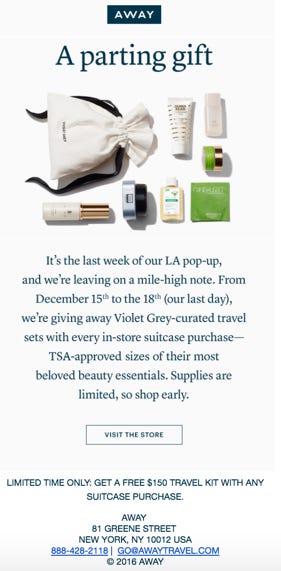
To create brand awareness in Los Angeles, Away partnered with Violet Grey, Hollywood’s leading artists and stars selection for cosmetics and beauty products.
For only 24 hours in the last week of the LA Away pop-up store, Violet Grey customers received a free carry-on luggage for orders above $500, limited to only 20 pieces. At the same time, Away customers purchasing from the pop-up store received a Violet Grey travel set.
The deal was featured in Violet Grey website and newsletter (150k customers).
5. Be relevant and specific when approaching a potential partner or the press
One of the reasons why Away was so successful with the press and partnerships is the fact that it reaches out to the right people, with all relevant information and a tailored message.
The Away team researches who is the right person to cover each story and reaches out to that person directly offering a carry-on luggage along with all relevant information required for an article or partnership, including high quality images (fundamentals for journalists).
Below some examples of emails to the press.
Outreach email
Subject: Holiday Collection // Away
Hi Lucinda,
Hope your week is off to a great start! I wanted to reach out and introduce you to premium travel brand, Away.
We would love to send an Away bag to accompany you on all your future travels. If interested, let us know which color you prefer (navy, black, green or sand) and the best address to send. Additionally, I’ve included information on our upcoming holiday collection, launching November 15th, below.
For the 2016 holiday collection, Away launches two special edition colors that reflect the palette of the season--the stark matte of white Snow and the rich grey Asphalt. They capture the modern winter experience, no matter what you celebrate (or don’t): waking up after a fresh snowfall to see a city blanketed in white, quite and calm, set against freshly salted streets. Just #snowandasphalt, as far as the eye can see. Hi-res images of the collection are available here.
Look forward to hearing your thoughts!
Thanks,
Ben
Reply to inbound request
Hi ___,
Appreciate you taking the time to reach out—it’s great to connect. We would love to send you The Bigger Carry-On, let us know if you had your eye on a specific color. I will follow up later this week with your tracking information once your suitcase is on it’s way, likely to arrive after the holidays. I’ve included images for your use here, as well as additional information on our brand, products and founders below.
Let us know if there was a specific angle you were interested in pursuing as we would be happy to support in anyway possible (quotes from our founders, industry research, # suitcases sold, etc).
About Away:
Launched in November 2015, Away is a new travel brand founded by Steph Korey and Jen Rubio (both Forbes 30 Under 30 and formerly of Warby Parker). Our focus and inspiration is movement: times of transition, exploration, and surprise. We create special objects that are at home on the road—that carry you forward, making your trip easier, and in a small way, your life better. We started with luggage.
Our Founders:
Jen Rubio and Steph Korey established premium travel brand Away to design and make products with the needs of the modern traveler in mind. They first met in 2011 as early executives at Warby Parker where Jen served as the Head of Social Media, spearheading content and partnership efforts, and Steph as the Head of Supply Chain, where she was responsible for building and leading the team in product development, manufacturing, and fulfillment. Jen and Steph then went their respective ways, while Jen led Innovation at AllSaints and Steph earned an MBA at Columbia Business School while consulting for mattress startup Casper on merchandise strategy and supply chain, before teaming up in February 2015 to launch Away.
Our Products:
Our full line of suitcases include The Carry-On $225, The Bigger Carry-On $245, The Medium $275 and The Large $295—all available in our four evergreen colors; Navy, Black, Green and Sand.
Start strong
Inside: two compartments, one designed for clothes, the other for shoes, toiletries, and the other hard objects. Outside: an impenetrable shell that bends under pressure, never breaks.
Power up
The Carry-On’s built-in battery can charge any USB device so you’ll always be able to check your maps, email, or slack.
Undress and compress
A nylon laundry bag separates clean clothes from dirty—even wet bathing suits are fair game. Buckle down the compression pad to clear up free space.
Settle back in
When it’s all over, Away bags next neatly inside each other, ready to be tucked away for next time (and save closet space in the meantime).
TSA-approved lock
Two zippers slot into a combination lock, so no one’s getting into your stuff but you (and the TSA).
Smooth ride
Premium Hinomoto wheels rotate 360 for a perfect roll every time.
Scratch resistant
The matte texture surface deflects scuffs and scrapes along the way.
The project Emma
One example of specific outreach and storytelling is the project Emma. Emma, 23 year old Instagram influencer, was in charge of the launch of the pop up store in London. Following the success of the store, Away decided to bring her to New York to work with the rest of the team permanently at the HQ. Unfortunately, strict US immigration regulations make it difficult to bring such a young person with little experience to US, so Away decided again to look for a way around. After performing a research, it found a writer from Forbes (Wes Gray) who covers stories about successful millennials and decided to craft a story for him that would generate press coverage.
Although not public yet, you can find the story below.
SUBJECT: Meet the 23 year old behind cult luggage brand Away’s global expansion
Hi Wes,
Hope you’re having a great week. I’m reaching out from Away, the direct-to-consumer premium luggage brand that launched earlier this year. Since you’ve written so many great articles about millennials who are really making a difference in their companies, we wanted to tell you about our 23-year-old Head of Global Marketing and Operations, Emma Bates.
We’re excited to talk for the first time about our plans for global expansion and Emma as the driving force behind that expansion. Since joining us over the summer, Emma has spearheaded our aggressive international growth strategy. In particular, she has:
● Led the expansion of Away’s digital footprint to five new countries
● Opened pop up shops in our two biggest European markets, London and Berlin
● Increased brand awareness and sales in Europe by more than 20x
Away is planning to quadruple year over year sales in 2017, and international expansion is a key driver of that growth.
Let us know if you’re interested in learning more about Emma and her role in leading global growth. Also happy to connect you with Away’s co-founders, Jen Rubio and Steph Korey, to discuss the impact Emma has had since joining Away.
Thanks,
Ben
6. Make your company look bigger than it actually is
In order to secure key partnerships and to position itself as a design brand, Away had to look big and professional already from the start.
The Lookbook
One of the earliest investments from Away was a professional photoshoot showing the founders, the product and several high quality lifestyle images. The photoshoot costed around $30k and it generated hundreds of assets that the company used for 6 months to populate the website and social medias, and to make Away look like a professional company.
The Press
The lookbook also served the purpose of equipping the press with all images for an article, so the effort required from journalists would be minimal.
In general the high coverage from press made Away look bigger and more influential, which helped generating interest from potential partners.
The Stores
Starting from early on, Away opened pop up stores in New York and more recently Los Angeles, London and Berlin. Showcasing a concrete product facilitated customers in making a purchase decision, helped partners assessing the quality and credibility of the brand and positioned Away as an international company. Today, Away has a permanent (and profitable) store in SoHo, New York.
The Community
Away built a strong community of influencers and happy customers which fuels word of mouth with an impressive amount of user generated content. Facebook posts, Instagram images and tweets from all over the world give the external perception that Away is everywhere.
7. Use influencers as your social media managers
Away is active on all key social medias: Instagram (29k followers), Facebook (13.5k likes and 4.8 star rating), Twitter (2.3k followers), Pinterest (1.7k followers) and Snapchat (0.5k contacts), with Instagram being the most important one:
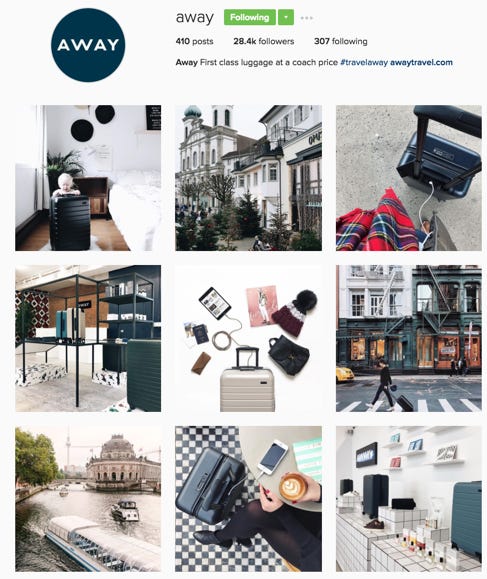
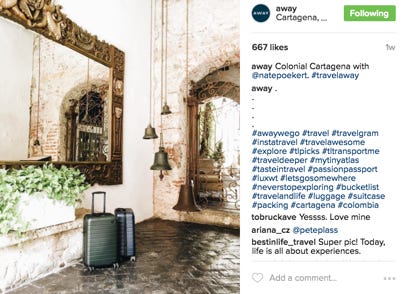
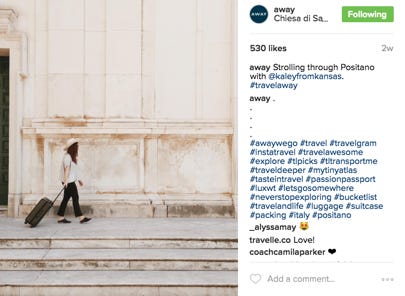
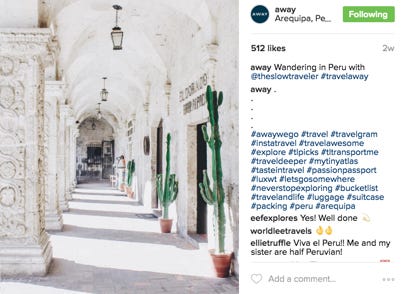
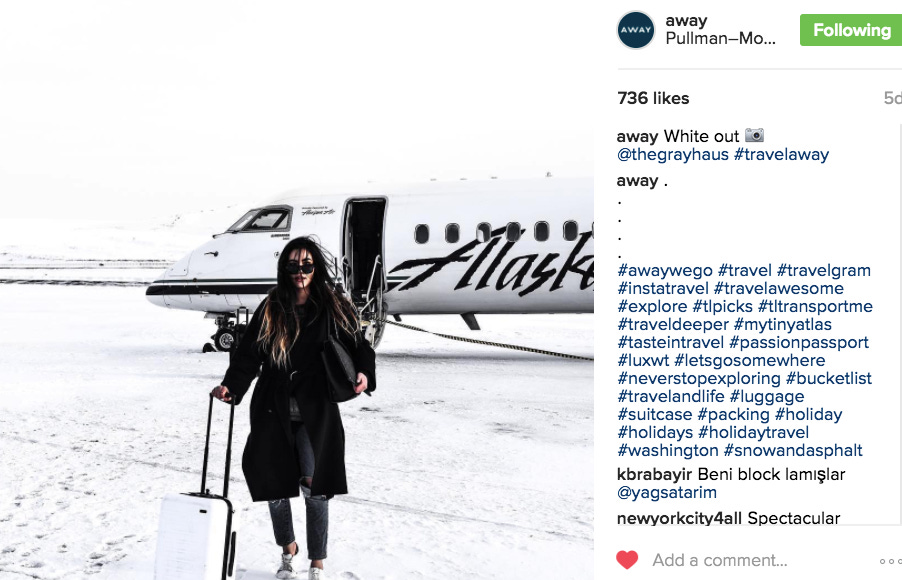
The Instagram account is curated with high quality images but what is special about the account is that most of these images are user generated content, coming from both customers and influencers.
Examples:
Influencer Marketing Strategy
Before working with the first influencers, Away arranged professional photo shooting in Panama. The photoshooting generated hundreds of assets that served the purpose of populating its social media channels with the first images and followers as well as creating the first lookbook for the press. High quality native content on social medias helped when reaching out to the first influencers as a fashion company.
After populating social medias with the first images, Away started reaching out to Instagram lifestyle, travel, tech and fashion influencers ranging from few thousands of followers to millions. To influencers with an average number of followers, Away sends a free carry on luggage for influencers to take pictures with and post. For influencers with a larger follower base, Away organizes exclusive events. For those influencers with a small number of followers instead, Away sends luggages returned from other customers (with a small scratch or defect).
Away never pays influencers with cash. This is possible with a fashionable consumer product. When viable, this is in general a better and cheaper strategy, as the influencer knows the price of the luggage but not the cost, i.e., the perceived value is higher.
As an effort to make Away an inspirational fashion brand, influencers do not post vouchers or discounts to push sales.
Especially for a company with a generic name such as Away, it is important to own a hashtag and educate influencers to use it. For away it’s #travelaway and #awaywego
One of the consequences of the point above is that the ROI of influencer marketing is not tracked. Only few KPIs such as reach and engagement rates can be estimated.
Influencers post high quality pictures with Away suitcases from all over the World. Not only producing these images in-house would be highly expensive (see above picture taken in front of a private jet in Moscow), but also checking in from several different locations makes Away appear as a global brand.
While the number of posts on the account is about 400, the number of times Away was tagged by customers and influencers is more than 1300 (~3x). With such a high amount of content produced by users, Away has the luxury to decide to show only the greatest images on its account.
All of this generates awareness of the brand among influencers. As of today, Away doesn’t have an influencer sourcing strategy, as it receives up to 30 inbound requests per day from influencers who want to start a partnership.
Away as a brand already became so well known among influencers that influencers use the partnership with Away to improve their credibility. There are some influencers who purchased a suitcase and posted on Instagram a picture of them with it along with a thank you message to Away, as to pretend the post is the result of a partnership.
8. Do not craft the message to your audience but to whom your audience aspires to be
One important aspect of Away strategy is the positioning of the brand as aspirational brand. The company targets millennials who aspire to be “modern travelers”.
Away believes anyone can go everywhere, the world is a shared place, and every trip is part of the exchange, no matter the destination. It believes in making connections: on the road, online, and in person. It values access over aspiration, and exploration over escape. All time away is time well spent.
The influencer community, with photos and check ins in every possible location, plays a key part in the positioning of the brand.
Use of “cheap” words is not allowed
To achieve an inspirational brand status, the use of words such as cheap, inexpensive, deal and discount are never used. In ads and editorials you rather see sentences such as “for a fraction of the price” or “the perfect carry on under $250”
Influencers don’t share voucher codes
Influencers are not allowed to share voucher codes when posting for Away. Sharing voucher codes would make the posts feel non spontaneous.
No banner ads, only advertorials
Very important, a high portion of conversions comes from sponsored content and revenue share deals, but none of this sponsored content is banners, it is always advertorials promoting the brand in a organically looking way.
Below two examples of successful advertorials on Business Insider and Lifehacker:
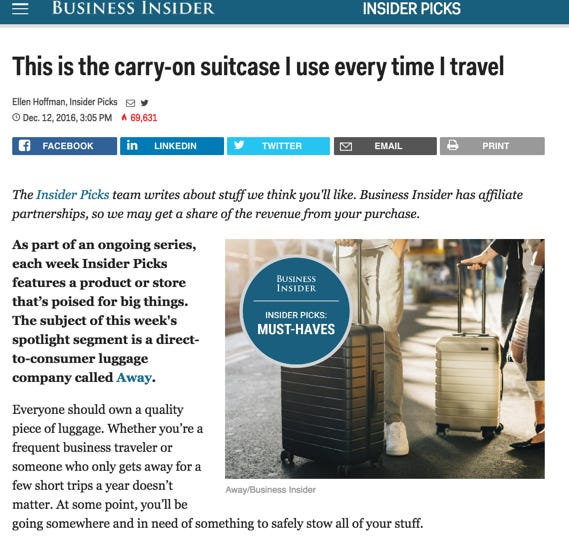
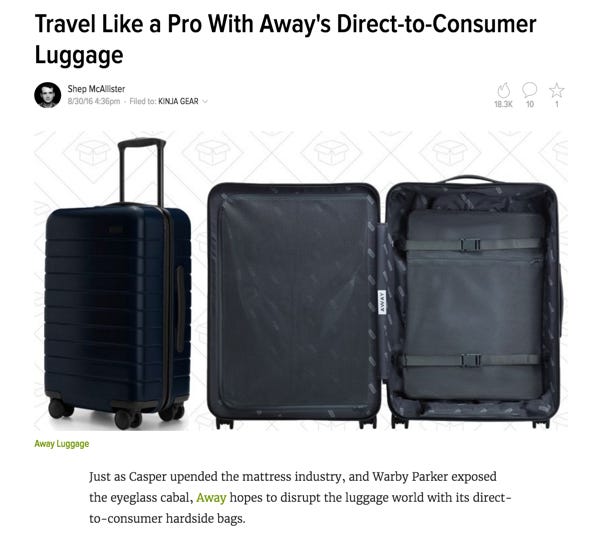
9. Turn your customers into your number one marketing channel
A good brand marketing strategy only works to amplify an excellent product and service. And this is in primis what the success of the company is predicated on.
The customer service of Away is trained to go above and beyond the expectations of the clients. Customers are so used to poor customer service that talking to someone who cares is an unexpected and refreshing surprise.
Away achieved a Net Promoter Score of 80 after one year of operations.
More than 10% of all sales come from the company referral program as of Google Analytics, but the effect of word of mouth is definitely bigger than that as not all cases of word of mouth are covered on Google Analytics.
Customer appreciation on Twitter, Facebook and Email


10. Never pay for what you can get for free
The whole company has a strong bootstrapping culture and every marketing manager is invited to think of ways to get things cheaper or for free.
Example:
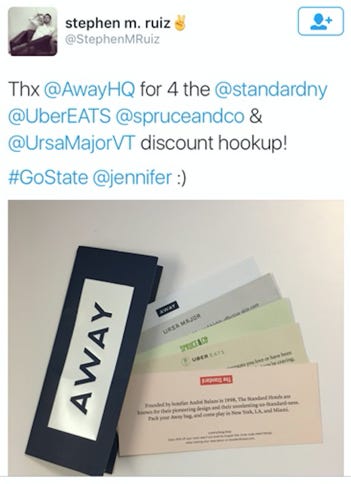
Away wanted to send a premium gift card to all of its customer base. The cost of this campaign would be $20k. Instead of investing this amount of money, Away reached out to several potential partners asking whether they wanted their gift card to be included in the send out for a price.
Including several gift cards from different brands such as Blade, Violet Grey, Outdoor voices, Vogue, Tommy John, UberEATS and Spruce&Co meant more value to the customers, to the brands and a free marketing campaign for Away.
Conclusion
Google Analytics doesn’t help measuring the success of Brand Marketing
If we were to evaluate the ROI of the brand marketing activities described above only based on sales as of Google Analytics, even with a proper attribution model, we would most likely stop all of them.
Most of the transactions for Away come from direct, SEM Brand and SEO Brand traffic sources.
Below you can see how the popularity of the search term “Away luggage” developed against “Tumi luggage”as of Google Trends, with Tumi being a much bigger competitor.
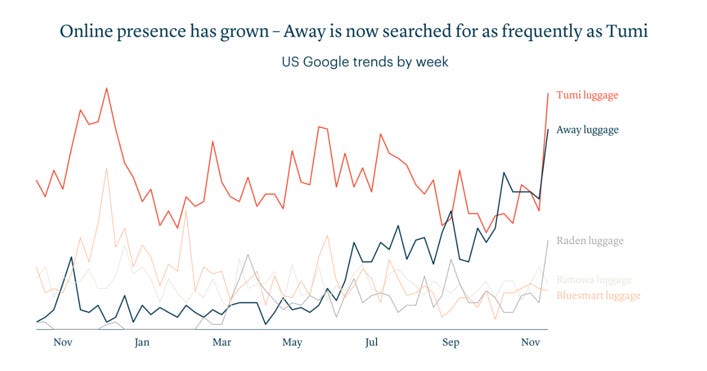
Even taking account the seasonality shown in the last two months of the year, it is impressive to see how quickly the brand popularity has grown.
Part of the organic traffic may be the resulting brand awareness generated from performance marketing ads, but such a steep curve does not usually come from investing in performance marketing ads.
The ROI of some of the brand marketing campaigns cannot be measured.
For example, the one below is a brand marketing campaign in Miami consisting of a suitcase mobile charging station which costed $5k overall. What is the ROI of that?
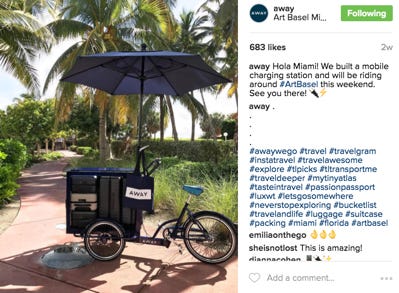
You can approximately calculate how much it costs to reach an audience, but there is no way to track sales.
As another example, no vouchers shared by influencers means there is no way to track influencer marketing sales from Instagram other than clicks on the link in the account bio, which we expect to be a small share.
Away does not measure the success of brand marketing campaigns based on ROI. As these are mostly “top of funnel” campaigns, the metrics evaluated are Reach, Engagement Rate and CPM.
Interdependency of marketing activities
Another important factor to take into consideration is the interdependency of all brand marketing campaigns, for example:
High press coverage facilitates partnerships.
Partnerships with popular brands make it easier to partner with other brands and often result in articles from the press.
Using Facebook ads to increase the reach of PR articles helps securing more organic coverage.
Co-marketing with partners also means more value for customers and cheaper marketing campaigns.
Pop up stores help with press and partnerships.
A big influencer marketing network increases word of mouth, global reach and brand awareness.
It is overall difficult to properly assess the standalone impact of each channel, when all of them are connected.
The team
Away team grew to ~30 employees in the last two months, including the addition of a Director of Brand Marketing from Uber. However, the team that made growth happen in the first phase was much smaller, and Jen, Co-Founder and Creative Director, was the person behind press, partnerships and brand marketing success.
Currently, with regards to marketing, there are only two people doing performance marketing acquisition, two doing brand marketing, two for pr, one for crm and six in creative services, mainly involved in design.
Budget allocation
If we were convinced that the right way to evaluate brand marketing impact is with reach, engagement and CPM KPIs, still the unsolved issue would be how to allocate budget between brand marketing and performance marketing campaigns.
Away splits the budget arbitrarily, with a marketing budget that is 15% of revenues and a 50/50 split between brand and performance.
Another approach would be to credit all direct, SEM brand and SEO brand traffic and sales to brand marketing campaigns and compare the CAC of these activities with that of performance marketing activities.
Important to say however, is that the personnel expenses behind a brand marketing team are often way higher compared to those required to run a performance marketing team (think about content production, copywriting, video and design resources), so the team structure should be taken into account when comparing the two.
Final remarks
Away is a great example of how a company can grow fast by building a brand already from the start. Away is still a young company, and it is now developing processes to scale. What Away did best was to start lean, build a great product first and then scale, while often startups scale and expand internationally before finding a product-market fit. This document and the tactics described should serve as inspiration to do a better job in building and growing a brand.
Not every business model is suitable for a brand marketing growth similar to Away:
High impact influencer marketing is easier for a high end company offering a physical product.
Press coverage from icons such as Vogue is possible for a company positioning itself as fashion brand.
Offering a great customer experience is tough when margins are tiny.
Engagement on social media channels, especially on Instagram, works best for travel, fashion, food and lifestyle companies.
And certainly, not every founder can drive such a brand success. Building a brand requires a long term vision, passion, inspiration and a great company culture.
Enrico Ferrari, Chief Marketing Officer at Rocket Internet
This nails why performance marketing alone fails in commoditized markets. The packyourbag.co hack was brilliant, turning a suitcase into a lifestyle container. What really stands out is weaponizing editor incentives by driving traffic to their articles, creating editorial dependency for future free coverage. I tried something similiar with a local outlet last year and the second placement was way easier. Surprising they didnt track influencer ROI, seems risky but the brand halo probly justified it.
They knew how to blend "Branding as Entertainment" throughout their journey and customer service is such an under looked, cost effective and easy way to get brand advocates - glad they used that too!
Will be interesting to decode why they weren't able to replicate the success globally, was the branding too Amercian?