

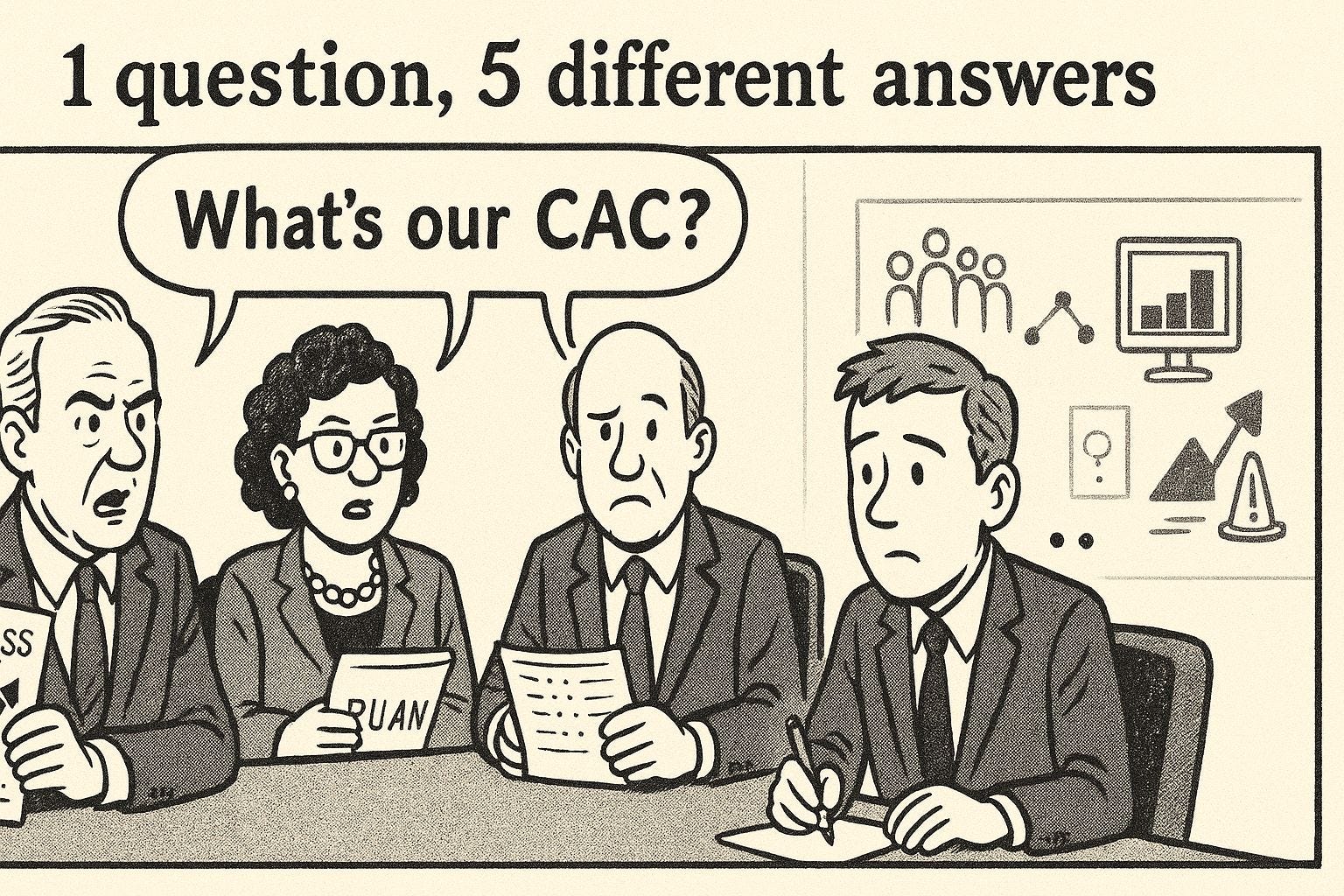
“What is your customer acquisition cost?”
Sounds like an easy question, right? Something you could just ask your analyst and get a number in return.
As a matter of fact, the reality is trickier.
Depending on whether you’re talking to your CEO, your CFO, or your Board, CAC can mean completely different things. In fact, there are five main types, and if you don’t know which one your audience is thinking of, you’ll end up talking past each other.
Here’s a breakdown of the five CACs that every marketer, founder, or growth leader needs to know before their next meeting.
1. Blended CAC
Definition
Blended CAC measures the average cost to acquire a customer, across all channels and campaigns. It’s calculated by dividing total marketing costs by total new customers acquired in a given period.
It’s the only CAC you can calculate deterministically, directly from financial and CRM data, without making attribution assumptions.
Numerical example
If you spend:
Paid ads (Google, Meta, TikTok): $80,000
Content marketing and SEO: $10,000
Total = $90,000
…and acquire 600 new customers, then:
This means that, on average, you spent $150 to acquire each customer.
Pros
Simple and certain
Works well for finance and board reporting
Good for tracking efficiency over time
Cons
No insight into which channels work
Masks inefficiencies between organic and paid
Takes credit for all new customers
Stakeholders
CEO/Founder, finance, marketing leadership, investors, analysts.
When To Use It
Early-stage companies without attribution data
Investor or board reporting
When channels overlap (brand, PR, organic)
Benchmarking performance across time
2. Fully-loaded CAC
Definition
Fully-loaded CAC includes all costs related to acquiring customers: direct spend (ads, agencies) and indirect overhead (salaries, tools, legal, creative production).
It’s the “real” CAC that represents what it actually costs to grow.
Numerical Example
Adding overhead to the previous case:
Paid ads: $80,000
Content & SEO: $10,000
Tools: $5,000
Salaries: $25,000
Agencies & freelancers: $15,000
Creative production: $10,000
Legal & compliance: $5,000
Total = $150,000
With 600 new customers:
150,000 ÷ 600 = $250 per customer
Pros
Reflects total economics of growth
Aligns with board expectations
Reveals hidden inefficiencies
Cons
Difficult to calculate precisely
Requires cross-functional collaboration
Subjective inclusion of certain costs
Stakeholders
CEOs, boards, finance, marketing leadership, FP&A.
When To Use It
Board meetings or fundraising
Budgeting and forecasting
Profitability analysis (LTV:CAC)
Mature or scaling companies with overhead
3. Incremental CAC
Definition
Incremental CAC measures how much you spend to acquire only the customers who wouldn’t have signed up otherwise.
It isolates the causal effect of marketing using lift studies and control groups. This CAC is the only one that attempts to measure causality. It gives a realistic picture of how effective marketing spend actually is at generating incremental revenue.
Numerical Example
A campaign spends $75,000 and brings 300 new customers.
A lift study shows only 200 were incremental (100 would have signed up anyway).
75,000 ÷ 200 = $375 per customer
Pros
Measures true marketing impact
Informs smarter budget allocation
Enables causal ROI analysis
Cons
Requires controlled experiments
Statistically sensitive to design and sample size
There’s an opportunity cost attached to holdouts
Stakeholders
Growth teams, analysts, marketing leadership, finance, CEO/Founder.
When To Use It
Testing new channels or campaigns
ROI or budget allocation analysis
Deciding whether to scale spend
Mature marketing orgs with experimental setups
4. Marginal CAC
Definition
Marginal CAC measures the additional cost of acquiring one more customer as you scale. It answers: “What will it cost me to get the next customer?”
It’s essential for identifying the point where acquisition becomes unprofitable, which is when:
Numerical Example
Suppose your company acquires 100 customers at a total cost of $20,000 (average $200/customer). You now spend an extra $1,000 to acquire one more customer (the 101st). Your marginal LTV is $750.
In this case, you are losing $250 ($750-$1,000) on that marginal acquisition. This means that it is not profitable to scale further.
Pros
Critical for profitability and scaling decisions
Reveals diminishing returns
Enables precise growth modeling
Cons
Volatile in small samples
Requires accurate, granular data
Hard to measure across blended campaigns
Stakeholders
CEO/Founder, growth teams, finance, boards, analysts.
When To Use It
Scaling campaigns or channels
Forecasting and profitability modeling
Dynamic LTV:CAC comparison
Setting stop-loss thresholds for marketing spend
5. Attributed CAC
Definition
Attributed CAC is the cost per customer as reported by platforms or attribution models (MTA, MMM).
It’s useful for comparing relative performance between campaigns and channels, but not for total cost analysis.
Numerical Example
Suppose your company spends:
Meta: $50,000 spend → 300 customers → $167 CAC
Google: $30,000 spend → 150 customers → $200 CAC
Great for relative comparisons within channels, but it doesn’t capture overlap, double attribution (in case of platform data), or organic conversions.
Pros
Easy to calculate and automate
Ideal for daily or weekly dashboards
Great for relative optimization
Cons
Doesn’t reflect total or incremental cost
Can mislead when channels overlap
Depends heavily on attribution model
Stakeholders
Marketing teams, growth managers, analysts, CMOs.
When To Use It
Channel and campaign optimization
Daily reporting and dashboards
A/B or creative testing
Not for strategic or profitability analysis
Closing Thoughts
CAC is one of the most abused metrics in marketing.
Everyone uses the same acronym but not everyone means the same thing.
If you want to sound credible in your next board meeting or CMO interview, make sure you know which version you’re talking about.
In short:
Blended CAC: the simplest average
Fully-loaded CAC: the true all-in cost
Incremental CAC: the causal one
Marginal CAC: the scaling one
Attributed CAC: the tactical one
The smartest companies track all five and know when to use which.
If you found this useful, consider sharing it with someone who keeps saying “our CAC went up” without knowing which CAC they mean.
And if you’d like me to cover “LTV from Zero to Hero” next, respond or leave a comment.
That’s where the real story begins.
Great content! Waiting for the next one on LTV 😍
Interesting read! Would love to read your piece on LTV/CLTV